Media Hub by Drone Federation India
Swarm Drone Technology’s Potential and Threats
- Category: Technology Trends
- Published: 2025-07-30
- Author: Sallangi Rahul Narayan
Article
The evolution of drone technology is shifting from individual aerial systems to intelligent, coordinated collectives known as swarm drones. Inspired by natural swarms seen in birds, bees, or fish, these drones work collaboratively, communicating in real time to complete complex tasks far more efficiently than a single unit ever could. From aerial displays to military reconnaissance and disaster response, smart technology is redefining the possibilities of unmanned aerial systems (UAS). As nations race to develop and deploy this game-changing technology, India too has joined the global momentum, recognising its strategic and commercial significance.
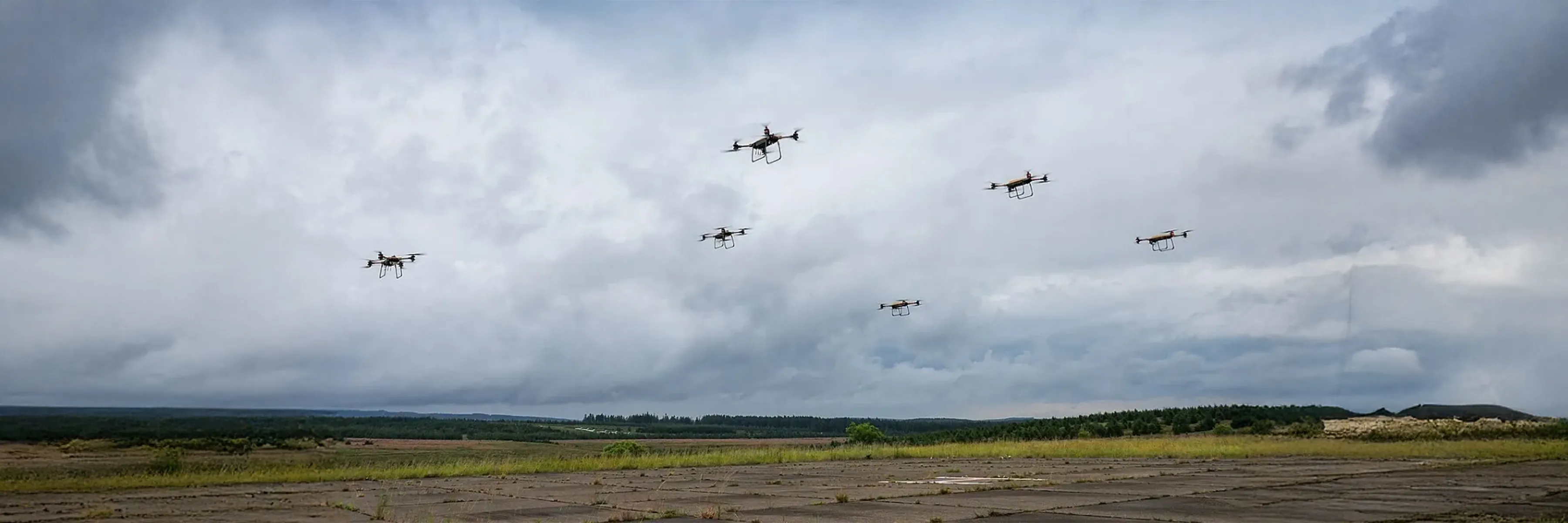
SWARM is an acronym for Smart War-Fighting Array of Reconfigured Modules, which uses distributed AI wherein each drone is treated as an intelligent node in a larger self-organising system. Swarm Drones are a group of drones(typically quadcopters or fixed wings) that collaboratively use decentralised or semi-centralised intelligence. These drones communicate with each other, make decisions collectively & execute coordinated manoeuvres without relying on constant human intervention. A swarm can vary in size, from a few drones to hundreds, depending on the mission and level of autonomy built into the system. Unlike the traditional drone operations, where a single operator controls a single drone, a swarm drone relies on algorithms and AI for coordinated functionality, shares data, avoids collisions and completes tasks cooperatively.
Beneath these advances lies the technical backbone that enables true swarm autonomy. Each drone behaves as an individual intelligent node. It possesses its own flight controller, edge computing processor (e.g., NVIDIA Jetson), communication modules (RF, LoRa, 5G), GPS(Global Positioning System)/RTK(Real-Time Kinematic) systems, and diverse forms of sensors such as cameras, LiDAR, or thermal imagers. Their propulsion system, power unit, and modular payload bay enable freedom of movement and mission-specific operations. The swarm functions through a coordinated loop of sensing, computing, communication, and execution. Once a mission is defined, drones are launched and use GNSS (Global Navigation Satellite System) and IMU(Inertial Measurement Unit) sensors to orient themselves in 3D space. They form a real-time communication mesh (often a Mobile Ad Hoc Network), sharing data continuously. AI algorithms guide formation flying, enable obstacle avoidance, support adaptive routing, and dynamic task allocation. Swarm architecture can be centralised (with a mother drone or ground station), decentralised (all drones make autonomous decisions), or hybrid. Decentralised and hybrid models are more resilient and capable of self-healing if a drone fails. Edge computing enables fast onboard decisions with minimal latency. As missions unfold, whether in reconnaissance, surveillance, or tactical engagement, drones adapt to changing environments without direct human control. An Armed Fully Autonomous Drone Swarm (AFADS) can locate targets, identify them, and strike them without human intervention. Depending on the objective, the swarm concludes by returning to base or executing one-time tasks such as self-destruction.
The history of swarm drones goes back to the early 2000s when academic research pivoted to multi-agent systems and decentralised control. This created the basis on which modern swarm technology is today. The expression "swarm robotics" was coined in 1991, but genuine scientific research and application blossomed only in the early 2000s. A key milestone was the SWARM-BOTS (2001–2005), internationally funded by the European Commission, which showed that up to 20 ground robots could give physical cohesion and cooperate in complex tasks. Subsequently, this set the foundations for the Swarmanoid project (2006–2010), which introduced the idea of heterogeneous swarms consisting of flying, climbing, and ground robots working together for search and retrieval tasks. Interest in swarm drones grew explosively in the 2010s, particularly within the defence and technology sectors, with powers experimenting with coordinated UAV flights for surveillance and combat. This was until a major leap was made with the 2015 launch of the Perdix project sponsored by the U.S. Department of Defence, demonstrating collaborative flight of autonomous micro-drones. China began to elevate swarm drone capabilities to strategic military importance. By the 2020s, swarm drones entered the public spotlight through mass drone light shows like those at the Tokyo Olympics. In India, startups like Botlab Dynamics emerged as leaders in drone-based aerial displays, signalling both technological maturity and widespread adoption of swarm systems.
Swarm drones have wide-ranging applications. Swarm drone technology is enhancing mission flexibility and resilience. In military operations, swarm drones are used for reconnaissance, surveillance, saturation attacks, and electronic warfare. At the maritime-domain level, AI-enabled swarms autonomously detect unauthorised vessels, relay real-time intelligence, and coordinate with shipborne systems for domain awareness. During offensive operations, swarm drones also serve as decoys to confuse enemy defences or offer jamming support to friendly aircraft. In the civil domain, these serve as precision crop health monitoring, aerial spraying, rapid disaster site mapping, entertainment purposes like drone light shows and survivors’ location in search and rescue. Applications include increased survivability through numerical redundancy, autonomous threat response, rapid deployment, and cost-effectiveness compared to manned systems. Their scalability, modularity, and capability to operate without GPS or communication links render them critical for India’s future combat doctrines.
India can draw vital lessons from global swarm drones to refine its capabilities. The U.S. military’s Perdix drones, released from F/A-18 jets, autonomously reconfigure mid-air and communicate in real-time. China’s CH-901 loitering munitions and truck-launched swarms showcase high-speed coordination and lethal precision. Russia's Lightning drones use AI-driven navigation and electronic warfare. These systems combine edge computing with GPS-denied navigation and machine vision, mounting robust ISR(Intelligence, Surveillance and Reconnaissance) and combat operations. India can incorporate AI-led decision-making, decentralised swarm logic, and hardened communication systems to increase survivability and efficiency.
As these global examples highlight the future of warfare, India’s parallel progress demonstrates how close it is to the other countries. In 2018, the Indian Air Force encouraged Indian startups to develop swarm UAVs for humanitarian and military applications through the Mehar Baba Swarm Drone Competition. Showing its increasing capability, in 2021, the Indian Army showcased the coordinated display of a swarm of 75 drones over a distance of 50 km at the Army Day parade. By 2023, the Indian Army had procured 100 swarm drones, including Beluga and Nimbus MK-III models, under a $15 million fast-track contract from the Bengaluru-based startup NewSpace Research & Technologies, thus marking the biggest operational step so far. This marks one of the first operational high-density swarming unmanned aerial systems for military purposes. Hindustan Aeronautics Limited (HAL) has partnered with NewSpace to develop advanced swarm drone systems for defence applications like the Air-Launched Flexible Asset Swarm (ALFA-S) drones, designed to enhance India's swarm warfare capabilities. 2025 is the year of introduction for Sheshnaag-150, the long-range autonomous swarm drone system. Thus, India’s warfare capabilities are strengthened by a strong technological foundation.
Swarm drones pose significant risks that cannot be overlooked. Under airspace safety, the simultaneous operation of large groups of autonomous unmanned aerial vehicles imposes collision risks, especially near civilian airspace. Cybersecurity threat is that inter-drone communications networks could be exploited through spoofing, jamming, or malware injection, compromising the whole swarm. Ethical and legal dilemmas do exist, especially concerning autonomous lethality. Opinions about public vulnerability, accountability, or breach against international laws remain contentious. Swarms may be weaponised in coordinated attacks against military bases or critical infrastructure, or to smuggle contraband across borders. The advancement of swarm capabilities being actively taken up by nations like China and Pakistan presents a strategic concern for India. Emerging research deliberates secure swarm networks, airspace deconfliction algorithms, ethical AI frameworks, and counter-swarm systems to counter the nations and to strengthen the strategic position. There is also a lack of regulatory standards for drone swarms like Type Certification. This calls for systematic standardisation and certification for Swarm drones.
India is well placed to lead the revolution in the Global South with strategic support through schemes like iDEX, Defence Testing Infrastructure Scheme(DTIS) and PLI(Production Linked Incentive Scheme) for drone and drone components. This requires partnering with Indian startups, MSMEs, academic institutions and the government to develop autonomous drone swarms for battlefield applications, electronic warfare, and combat reconnaissance. With possible threats from drone swarms and the need for a proactive defence, the government has formulated initiatives towards developing full swarm drone capabilities. The Autonomous Underwater Swarm Drones Challenge is an initiative to build underwater drone swarms for surveillance and reconnaissance, enhancing maritime security. ALFA-S (Air Launched Flexible Asset – Swarm Drones) seeks to pursue the development of air-launched swarm drones that may be deployed from various aerial platforms. Yet another very pertinent initiative is the EAD (Expendable Active Decoy) Swarm, which aims to build high-speed drones armed with chaff dispensers and electronic warfare payloads aimed at overwhelming enemy air defence systems and safeguarding friendly aircraft.
The Swarm Drone Technology is evolving, coordinating complex operations between the civil-military sectors. The strides made by India in indigenous development and operational deployment exemplify that the country is meant to exploit this technology toward enhanced security and efficiency. Apart from innovation, we are concerned with cybersecurity, airspace control, and ethical use, developing countermeasures, and operating within robust regulatory frameworks. Technologies such as 5G, AI, edge computing, and numerous others will skyrocket the future evolution of swarm drones, building on intelligence and efficiency. Designed with ultra-low latency and high bandwidth, 5G will enable drones within a swarm to communicate with each other with no delay while sharing data and coordinating actions, responding in isolation to a constant yet dynamically changing environment. However, AI algorithms that use edge computing devices will empower drones to process sensory data locally and make autonomous decisions in real-time. This interplay increases the swarm's scalability and operational precision. Thereby ensuring the smooth and correct execution of bigger and more complex missions involving coordinated surveillance, search-and-rescue, or tactical military operations.
A resilient, technological, self-reliant ecosystem is being built in India through collaboration between researchers, government and industry to ensure focused Funding, Research and Development for swarm technology to meet market needs and demand. This collaboration strengthens defence and creates a path in agriculture, disaster management, and surveillance. Set to become a major drone technology leader by the year 2030, India is transforming itself into a key innovation centre and exporter of sophisticated UAV solutions. Successively, this would be conducive to the country’s overall aspiration of technological sovereignty and global influence. Thus, swarm drones are positioned to become a pivotal force for defining the future landscapes of war, security, and civilian applications worldwide.
References:
http://cleveralgorithms.com/nature-inspired/swarm.html
https://theprint.in/defence/army-gets-its-first-set-of-offensive-swarm-drone-system-iaf-next/1368508/
https://d1wqtxts1xzle7.cloudfront.net/61507015/ADR-2019_Armed_sUAS_Swarms-The_Big_Threat_of_Small_UAS-libre.pdf?1576272612=&response-content-disposition=inline%3B+filename%3DArmed_sUAS_Swarm_Big_Threat_of_Small_UAS.pdf&Expires=1748846638&Signature=FFnOtKY~ZgN0nAXkgh1ag9yIj~MM6QHTATty3P7Pa0zioI9NO-xsjvQ2rIHHH5rgsSsPdvh2FZBmIPR4gIHTmSl4pnHMBQ~WjnrDuGDXjMvn-YoShYYtUlVqVBqKHD-0PYnKFez-udSRxsew7w73FHc8298YbZtYHJH4VZbf5pSEBEnfd3MK5CXBsjm8F3qNfNpsoheVjMuQsMqvOyGT7F9ygjfNaJKl1b9jteLtd8wGGCmJvDsUBsOcoqijGKWR59zVdfFUPo08pkQQRLUdjQgjTSkN~9yWZS1e8xkITSssiIl0e-xkzsTZ9mLwj8MfMrFABLGiHi62nSp7haer~g__&Key-Pair-Id=APKAJLOHF5GGSLRBV4ZA
https://www.iadb.in/2024/12/31/swarm-intelligence-collaborative-unmanned-drone-systems-for-maritime-surveillance/
https://www.cnbctv18.com/business/delhi-based-startup-wins-36-million-swarm-drone-deal-from-indian-air-force-17689121.htm
https://pwonlyias.com/current-affairs/swarm-drones/
https://www.spslandforces.com/story/?id=747&h=Swarm-Drones---New-Frontier-of-Warfare
https://www.jagranjosh.com/general-knowledge/what-are-swarm-drones-check-range-speed-and-other-details-1746814204-1
https://www.pib.gov.in/PressReleseDetailm.aspx?PRID=2101131#:~:text=The%20MBC%2DII%20was%20launched,solutions%20to%20specific%20problem%20statements .
https://www.pib.gov.in/Pressreleaseshare.aspx?PRID=1688807
https://www.pib.gov.in/PressReleseDetailm.aspx?PRID=2101617
https://www.pib.gov.in/PressReleaseIframePage.aspx?PRID=1793266
https://www.sps-aviation.com/experts-speak/?id=703&h=Armys-Offensive-Drone-Swarm
https://core.ac.uk/download/pdf/578755277.pdf
https://ieeexplore.ieee.org/abstract/document/9048609?casa_token=KL_6_zEjEl0AAAAA:b_QLk3O3qhjh9645cfDr6_Hv8kcOzBVQafHcNRv8aCrRaYyGj2zT1nIGGcZ-l7G7PFuolHFbaok
https://www.sciencedirect.com/science/article/abs/pii/S1047831023000147
https://link.springer.com/article/10.1007/s42979-024-03156-x
https://ieeexplore.ieee.org/abstract/document/9214446
https://www.cnbctv18.com/technology/india-swarm-drones-future-warfare-operation-sindoor-pakistan-19604639.htm
https://www.asisonline.org/security-management-magazine/latest-news/today-in-security/2023/september/drone-swarms-good-bad-and-terrifying/
https://www.linkedin.com/pulse/swarm-drones-india-next-frontier-defense-agriculture-aman-raj-gurqc
https://www.indiandefensenews.in/2025/05/newspace-research-technologies-delivers.html
https://www.defensemedianetwork.com/stories/dod-successfully-demonstrates-aerial-autonomous-drone-swarm/?
https://en.wikipedia.org/wiki/CASC_CH-901
https://en.defence-ua.com/weapon_and_tech/whats_the_russias_new_ai_powered_shahed_136_and_what_its_capable_of-13011.html
https://automatedresearch.org/weapon/israel-aerospace-systems-harpy-loitering-munition/
Page: https://www.dronefederation.in/media-hub/swarm-drone-technology-potential-and-threats